%201.svg)

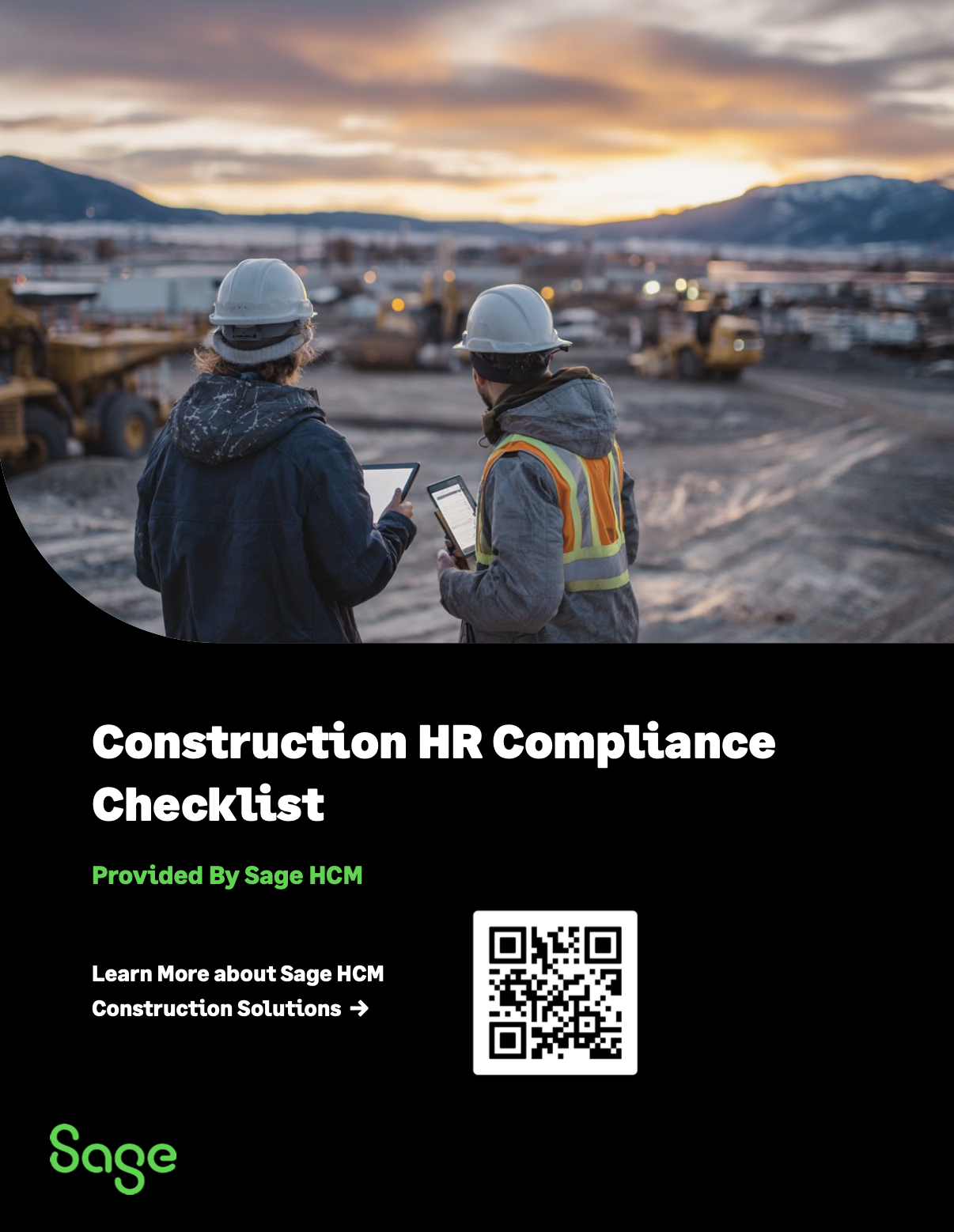

Roughly 10–19% of construction workers in the U.S. are misclassified or paid off the books. That means nearly one in six workers might be missing out on key protections.
It also means certain companies are out of compliance and could be at risk of major fines.
But construction teams already have their hands full managing full-time and part-time workers, seasonal crews, subcontractors, and union employees — and all their different pay rules and classifications.
With so many moving parts, maintaining compliance can seem like putting out hundreds of little fires every week.
But compliance doesn’t have to feel impossible.
We’ve developed this Construction HR Compliance Checklist to help you thoroughly audit compliance in your organization before you hear from the regulating bodies.
Start reviewing your processes and build smarter workflows that reduce errors.
Download the checklist today →
What Is Construction HR Compliance?
Construction HR compliance involves following all the laws and regulations that govern how you hire, pay, train, and protect your workforce.
Because construction workforces are so varied, compliance can include everything from wage and hour rules to safety training, benefits eligibility, and recordkeeping.
Compliance may also cover:
- Union agreements
- Prevailing wage rates
- Certified payroll reporting
- OSHA safety logs
- Equal opportunity requirements
- Data privacy
Why It Matters
Compliance protects both your business and your workers in several ways:
- Audit Risk: The DOL, IRS, and state labor boards all conduct audits. Even one missed record or misclassification can trigger a full-blown investigation.
- Eligibility for Public Works: If your certified payroll or fringe benefit reporting is incomplete, you could lose access to government-funded projects.
- Penalties: Violations can lead to heavy fines, back pay, and possible project suspension. OSHA’s top penalty for “willful” or repeat violations is $165,514 per incident.
- Reputation: Contractors known for compliance earn trust with clients, partners, and unions. Violations harm credibility and may lose bids.
How We Built This Checklist
This resource addresses the key regulators that oversee construction HR and payroll practices, primarily:
- The Department of Labor (DOL)
- Occupational Safety and Health Administration (OSHA)
- Equal Employment Opportunity Commission (EEOC)
- Internal Revenue Service (IRS)
The checklist focuses on construction HR compliance in the United States in 2025, covering union agreements, prevailing wage laws, multi-state payroll, and certified payroll reporting. However, many of these items may apply to HR departments in several other industries as well.
Download the checklist today →
{{inline-cta-products-hr="/style-guide"}}
Hiring & Eligibility Basics
Before you worry about training, safety, or payroll, be sure you’re hiring people correctly. Improper worker classification can lead to back wages, unpaid taxes, and lost eligibility for public contracts.
I-9 and Right-to-Work Documents
Every U.S. hire must complete Section 1 of Form I-9 by their first day of work. Employers must complete Section 2 within three business days after the start date by examining original, unexpired identification documents.
Keep each I-9 on file for three years after the hire date or one year after termination, whichever is later.
TIP: You cannot tell employees which documents to provide. Any valid options from Lists A, B, or C are acceptable.
E-Verify (Where Required)
At the federal level, E-Verify is voluntary for most employers, but required for covered federal contractors under the FAR E-Verify clause. It must be used for employees working directly on the covered contract.
Some states have additional E-Verify mandates, so always confirm your local requirements.
New-Hire Reporting
Report new and rehired employees to the state where they work within 20 days of hire.
NOTE: Some states require shorter timeframes.
Reports typically include the employee’s name, address, Social Security number, and start date. Each state provides its own online portal for submissions.
Employee vs. Contractor Tests
Under the Fair Labor Standards Act (FLSA), the Department of Labor uses the “economic reality” test to determine whether a worker is truly an independent contractor. The key question: Is the worker economically dependent on your company?
The DOL and IRS both look at multiple factors, such as:
- Control over work
- Opportunity for profit or loss
- How integral the job is to your business
Review these carefully to ensure each person gets the pay and protections they’re entitled to.
Sub-Tier Documentation
Keep clean, accurate records for every contractor and subcontractor:
- Tax identity: Collect a signed Form W-9 from each subcontractor or vendor, and retain it according to IRS requirements.
- Risk and insurance: Obtain and verify Certificates of Insurance (COIs) from all subcontractors, confirming coverage and expiration dates. Requirements vary by owner and project type, so verify what’s needed up front.
Wage & Hour (FLSA + State Variations)
Wage and hour laws are two of the most closely watched areas of HR compliance. Construction crews often work long shifts, cross state lines, or change job types mid-project. All of these can affect how you calculate pay.
Overtime Rules
Under the Fair Labor Standards Act (FLSA), non-exempt employees must earn 1.5× their regular rate for any hours worked beyond 40 in a workweek. “Regular rate” includes most forms of pay, such as hourly wages, bonuses, and shift differentials.
Some states, like California, go further, requiring daily overtime after eight hours or double time after 12. Always check the rules in the state where your crew is working before assigning shifts.
Travel Time
Whether travel time counts as paid work depends on the situation. Travel between job sites during the workday must be paid. Ordinary home-to-work travel usually isn’t.
For longer trips or mobilizations, review DOL Fact Sheet #22 to confirm what’s compensable.
Meal and Break Periods
Although the FLSA doesn’t require them, breaks are still regulated:
- Short breaks (5–20 minutes) count as hours worked and must be paid.
- Meal periods (about 30 minutes) are unpaid only if the worker is completely relieved of duty. If they must keep working or stay on call, that time is paid.
- Some states, including California, require specific meal and rest breaks for certain shifts, so check local laws.
On-Call Time
If a worker must stay on-site or can’t use on-call time for personal reasons, that time counts as hours worked.
If they’re free to use their time as they wish and only need to respond when called, it’s generally not compensable. Apply the 29 CFR 785.17 standard to your on-call policies.
Prevailing Wage and Davis-Bacon (Public Works)
If your company works on federally funded or assisted construction projects, Davis-Bacon and Related Acts (DBRA) compliance is non-negotiable. These laws ensure workers on public projects are paid no less than the locally prevailing wages and benefits for their craft and location.
Wage Determinations & Classifications
Start by pulling the correct wage determination from SAM.gov. Match the determination to the project’s county and craft, and use the listed classifications and rates for the work actually performed (not just the worker’s title).
If the contract is modified, check whether an updated determination applies.
Posters
At every covered job site, post both the official wage determination and the Davis-Bacon poster (WH-1321) in a visible, accessible spot for workers.
Weekly Certified Payrolls
When the Davis-Bacon and Related Acts (DBRA) apply, ensure weekly certified payrolls (Form WH-347 or equivalent) are submitted with the Statement of Compliance (page 2 of Form WH-347).
Under 29 CFR 5.5(a)(3)(ii) and the Copeland Act, you must pay covered employees weekly and submit certified payrolls each week to the contracting agency or designated authority. Follow your contract’s instructions carefully, as deadlines can vary.
Fringe Disclosures
Report all fringe benefits accurately, whether paid in cash or through bona fide plans. List hourly credit values for each worker as required on the certified payroll or Statement of Compliance.
Flow-Down Clauses
On federally funded or assisted projects covered by Davis-Bacon, prime contractors must enforce labor-standards clauses in every subcontract. That means checking that wage determinations, certified payrolls, and other required terms appear in every lower-tier contract also.
Failure to “flow down” these clauses can leave the prime contractor responsible for any sub’s back-wage liabilities.
For broader federal work, attach the relevant FAR or agency clauses to each subcontract.
Payroll Tax and Multi-State/Locality Compliance
Construction companies often work across multiple states and local jurisdictions.
Managing tax rules correctly for each location is essential for avoiding penalties (and staying efficient). Every time you set up a new job site or hire in a new location, double-check your obligations.
SUTA/SUI (State Unemployment Tax/Insurance)
SUTA/SUI is a state-level payroll tax paid by employers that funds unemployment benefits for workers who lose their jobs.
Register in each state where you have covered employees. Liability for this tax usually begins once you pay wages or have active workers in that state.
For example, the New York Department of Labor (NYSDOL) states that a general business becomes liable on the first day of the calendar quarter in which you pay $300 or more in compensation.
Local Taxes
Some states require employers to withhold local income taxes in addition to state and federal taxes.
For example, Pennsylvania’s Act 32 mandates Earned Income Tax (EIT) and Local Services Tax (LST) withholding, while many Ohio municipalities collect local taxes through RITA. Multi-site projects may need multiple local accounts and location codes to stay compliant.
Nexus Triggers
If your team performs physical work in another state, you’ll need to set up a payroll-withholding nexus there, and you must withhold that state’s income tax while employees are performing services in that location.
States like New York and New Jersey have specific “source-based” rules. Always confirm requirements before sending crews across state lines.
Per-Diem Taxability
Follow the IRS accountable plan rules for per diem.
For instance, payments that meet federal rates and require documentation are non-taxable.
However, any excess or unsubstantiated amounts must be treated as taxable wages, reported on the W-2 and subject to withholding.
Union Dues
Collective Bargaining Agreements (CBAs) set the rules for union pay rates, deductions, and benefits. Those terms can change from one local to another.
Dues must be deducted from payroll exactly as outlined in each CBA. The rates and frequency vary by union, and in many cases apply to every paycheck. Missing or miscalculating dues could trigger audit findings.
Variable Wages by Union Local
Union-regulated pay rates for the same trade can differ across locals or states. When employees work across multiple jurisdictions in a single pay period, you must apply the correct local rate for each location and classification worked.
Tracking this manually can get messy fast, especially on multi-site or traveling projects.
Safety Training & Recordkeeping (OSHA 29 CFR 1926)
Safety compliance in construction isn’t just about avoiding fines, but protecting people. Under OSHA’s construction standards (29 CFR 1926), employers must train workers to recognize hazards and maintain accurate safety records.
For HR teams, proper documentation shows that your crews are trained and your sites are safe in case of an audit.
Required Training
Provide general and task-specific training so workers can recognize and avoid hazards (1926.21). Training should include topics like:
- Fall protection (1926.503)
- Scaffold safety (1926.454)
- Hazard communication (HazCom) for chemical use (1910.1200)
Document each session with the trainee’s name, trainer, date, and topics covered.
Logs
Keep training proof and required OSHA logs organized:
- OSHA 300 (Log of Work-Related Injuries and Illnesses)
- OSHA 300A (Annual Summary)
- OSHA 301 (Injury and Illness Incident Report)
Retain records for five years, post the 300A summary from February 1 to April 30, and submit electronically via OSHA’s Injury Tracking Application (ITA) if required.
Incident Reporting
If a serious incident occurs, report it promptly:
- Report fatalities within 8 hours
- Report any in-patient hospitalizations, amputations, or loss of an eye within 24 hours
(Per 29 CFR 1904.39)
To stay on top of this aspect of compliance, create a workflow to capture, review, and report incidents on time.
Postings
Display the free OSHA “It’s the Law” poster in a visible location. Also, post the 300A summary during the annual reporting window and any OSHA citations near the affected area until corrected.
EEO / Anti-Discrimination and Harassment Prevention
Creating a fair, respectful workplace is a cornerstone of compliance. Construction environments can be fast-paced and diverse, so it’s important to set clear expectations, communicate rights, and respond to complaints quickly.
Federal rules under the Equal Employment Opportunity Commission (EEOC) apply to most employers, with additional requirements in some states.
Postings
Display the current EEOC “Know Your Rights” poster prominently, either in print at the jobsite or digitally if your workforce is remote.
Use the Department of Labor’s Poster Advisor tool to check for any other required postings (for example, state-specific discrimination notices).
Complaint Pathways
Establish clear, accessible reporting channels for workplace issues. Workers should know exactly who to contact (whether that’s a supervisor, HR, or safety officer) and that they can also file directly with the EEOC online or by phone.
Train managers to take all complaints seriously, document them promptly, and escalate through the correct internal process.
Training
Provide regular anti-discrimination and anti-harassment training for both employees and supervisors. Cover your company’s policy, what counts as discrimination or harassment, and how to report these issues.
- Train managers on retaliation prevention so they understand that punishing someone for reporting or participating in an investigation violates EEOC guidance.
- Some states require annual anti-harassment training. Confirm your local rules and keep proof of completion.
Data Privacy & Access Controls
Protecting employee data is a core part of HR compliance. Construction firms handle sensitive HR, payroll, and safety information, so it’s important to limit access and follow strict data security protocols.
Role-Based Access
Limit who can view or edit HR and payroll data to only those who need it. Use a least-privilege approach — HR staff, payroll specialists, safety managers, and project administrators should each have defined access levels.
Keep activity logs for every user. Store any medical or ADA-related information separately and mark it as confidential.
Retention Schedules & Secure Sharing
Maintain a document control process that keeps records for the legally required time and allows safe sharing with auditors or regulators.
Here are the main federal record-retention requirements:
- FLSA (Payroll): Keep payroll records for 3 years and supporting documents (like timecards, rate tables, and schedules) for 2 years.
- ADEA: Retain age-related and core payroll records for 3 years.
- EEOC (Title VII/ADA): Keep personnel and employment records for 1 year or longer if a charge or litigation is pending.
- Form I-9: Retain for 3 years after hire or 1 year after termination, whichever is later.
- State privacy laws (like California’s CPRA) may require you to disclose your retention policy for employee data and limit how long personal information is stored.
{{inline-cta-solutions-construction="/style-guide"}}
How To Improve Compliance for Your Construction Company
Leading companies don’t achieve great compliance through a single audit. They establish processes that keep their organization aligned with the regulations that matter to them.
Here are some tips for how to make your HR compliance stronger for a construction context.
Keep Employee Handbooks Current
Maintains an up-to-date employee handbook with clear, accurate policies. This resource should spell out behavioral expectations and reporting steps (among other items) in plain language.
Make sure it’s accessible to everyone, including field crews, office staff, part-timer employees, and subcontractors alike.
It's best practice to review and update handbooks at least once a year to reflect new standards.
Improve Communication
Some compliance issues stem from poor communication (e.g., an important memo gets missed or a concern is mishandled).
Build clear communication policies so employees can safely share concerns.
- Train supervisors to handle complaints and feedback
- Use platforms to log, route, and resolve issues
- Implement a ticketing or reporting system that alerts the right person when an issue needs attention
Good communication helps you catch problems early, before they turn into violations.
Conduct Regular Compliance Audits
Review your HR and payroll systems often to ensure records are accurate and policies are being followed. Run reports on:
- Payroll accuracy
- Wage classifications
- Safety training
- Document and data handling procedures
Keep those reports on file in case of a state or federal audit. Periodic reviews help you spot and fix weak points before they cause fines or delays.
Stay on Top of Laws and Industry Standards
Labor laws and safety rules change frequently. Any team dealing with multiple states or union jurisdictions needs to keep track of it all:
- Wage and hour laws by state
- Union rules and CBAs
- OSHA safety regulations
- Recordkeeping laws
- Security certifications
If possible, dedicate staff or in-house experts to monitor updates and communicate changes to your team.
Use an HCM Platform to Manage Compliance
An HCM platform is the most reliable way to manage compliance at scale. The right system helps you:
- Stay on top of changing laws and apply correct calculations automatically.
- Maintain clean records in one place.
- Control access and manage document permissions securely.
- Save time and reduce manual errors that lead to compliance gaps.
Sage HCM does this by combining HR, Payroll, and Talent tools in one secure platform. Backed by a team of experts, we’re purpose-built for construction companies that need accuracy, efficiency, and peace of mind.
How Sage HCM Solves Construction HR Compliance
In construction, managing HR compliance in this space requires detailed oversight.
Sage HCM helps you maintain compliance at scale with one unified platform. What used to take hours of manual work is now largely automated.
- Simplifying Hiring and Eligibility: Sage automates onboarding for every employee type and securely stores documents for clean audit access.
- Compliant Worker Classification: Our powerful and expansive HRIS keeps all employee data including hiring documents and position history all in one place.
- Simplified Complex Payroll: Configurable pay rules automate overtime, travel, and tax calculations across states for faster, more efficient payroll.
- Union, Fringe, and Public Works Compliance: Sage manages union rates, fringe benefits, and custom reporting. Generate certified payroll reports and more with ease.
- Safety Training, EEO, and Recordkeeping: The built-in LMS tracks and assigns all required training by project or role while monitoring completion status automatically.
- Data Privacy and Audit Readiness: Role-based permissions and document-control workflows keep employee data secure and compliant.
- Integration, Accuracy, and ROI: Sage HCM integrates with industry-leading software like Sage Intacct and Procore to sync payroll, projects, and labor costs and provide better insights to HR leaders.
Sage helps you check all the boxes for construction HR compliance. You get fewer errors, faster audits, and complete visibility.
Download the Construction HR Compliance Checklist
Compliance in construction HR isn’t a one-time concern. It’s an ongoing process that should involve regular audits. A proactive approach today can save your company’s time, money, and reputation tomorrow.
Sage’s Construction HR Compliance Checklist can help you tick all the boxes. Get your free, regulator-cited checklist (PDF + XLSX) to keep your HR, payroll, and safety processes aligned and audit-ready.
Download the Construction HR Compliance Checklist today →
Want to see how Sage HCM helps construction companies simplify compliance, automate payroll, and more? Get a demo today!