
%201.svg)



If your Fridays are spent chasing timecards or cleaning up spreadsheets, you’re not alone. Studies show construction professionals lose up to 35% of their time on non-optimal tasks.
That wasted effort starts in the back office. HR teams struggle with disconnected tools, manual data entry, and complex systems that don’t talk to each other. All this leads to errors, missed deadlines, and compliance risks.
But the problem isn’t your effort. It’s your software.
Most HR systems claim to be “complete,” yet few are actually built for construction. They’re often expensive, clunky, and missing core features like certified payroll, union handling, or multi-entity support. Sometimes, premium add-ons are required for what should be standard features.
So how do you fix the admin problem without rebuilding your whole tech stack?
You need an HRIS built for construction — one that connects HR, payroll, and project data in a single system.
This guide compares the 7 best construction HRIS platforms, focusing on the features that matter most: certified payroll, union configuration, ERP/PM integrations, and reporting tools to help your team work smarter and stay compliant.
{{inline-cta-products-hr="/style-guide"}}
At a Glance: 7 Best HRIS Systems for Construction Companies in 2026
How We Chose HRIS Tools for This List
Many tools look great on paper but fall short when they meet the realities of construction work. That’s why we focused our list on feature relevance, compliance, reporting, and integrations. While not every platform on this list checks every box, we picked those that get most of it right.
We reviewed each platform using a construction-specific rubric that scores across these key areas:
1. Features That Matter to Construction
A strong construction HRIS goes beyond basic HR tasks to handle field realities like multiple pay rates, certifications, and job roles. The best platforms provide full visibility across crews and projects, plus built-in learning tools for safety, compliance, and skills development.
2. Compliance and Payroll Strength
Certified payroll, union rules, and prevailing wage laws demand precision. Top systems automate WH-347 reports, manage union rate tables and fringes, and handle multi-state taxes accurately.
They should also simplify OSHA reporting so HR teams can stay compliant without extra manual work.
3. Job Costing, Accounting, and Reporting
The right HRIS connects people data directly to project finances. We looked for job-cost and GL mapping functionality, plus configurable reporting tools that track labor costs, compliance, and taxes across entities.
4. Field Accessibility and Integrations
Field reliability is non-negotiable. Leading systems offer mobile or kiosk time capture that works offline and syncs cleanly later. Verified integrations with tools like Sage, Trimble Vista/Spectrum, Procore, Acumatica, and Dynamics keep HR, payroll, and project data in sync.
The 7 Best HRIS Systems for Construction
1. Sage HCM
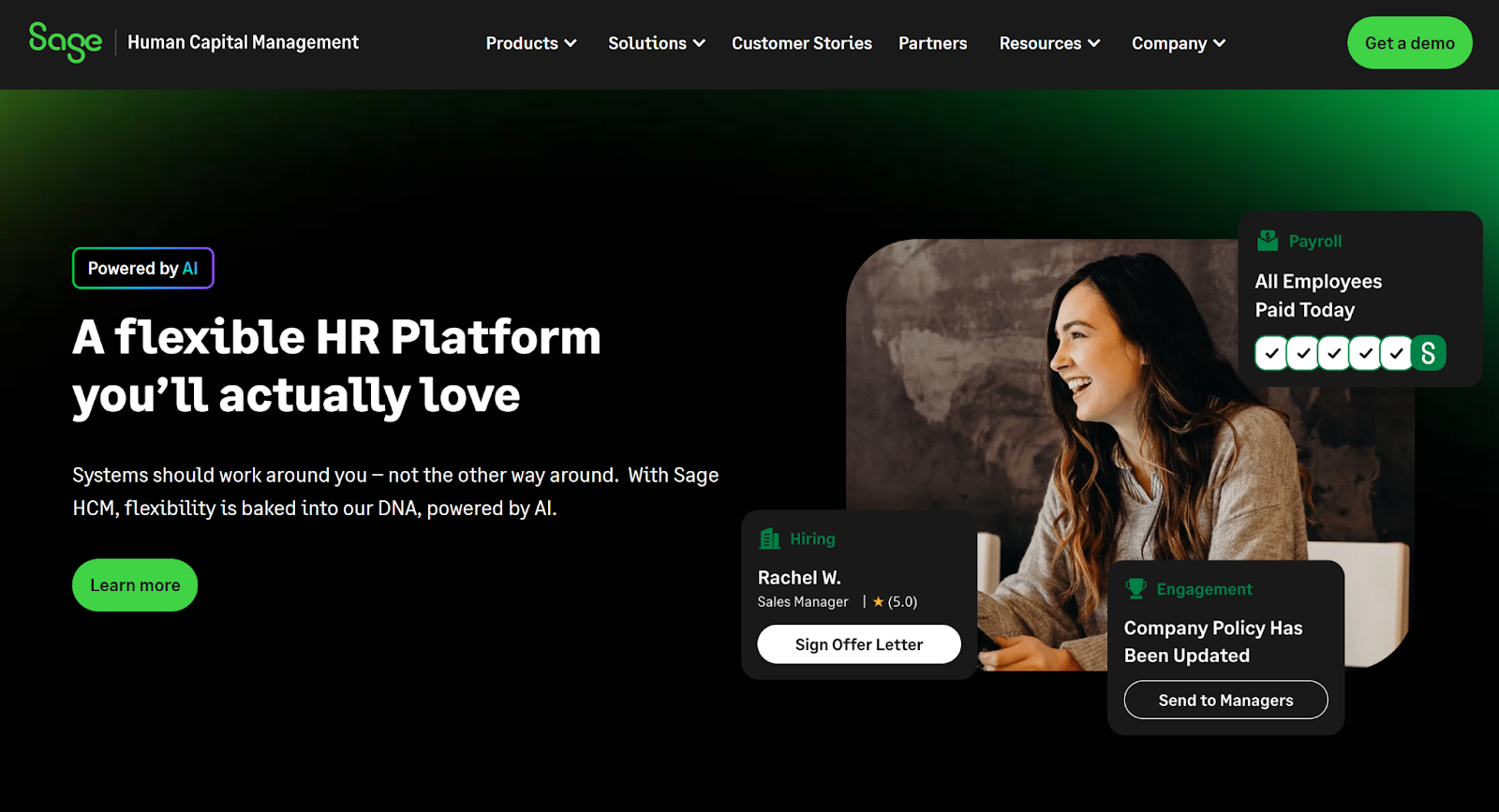
Sage HCM is one of the few HRIS platforms built specifically to manage the complex payroll and compliance needs of construction and engineering companies.
It’s a unified HCM platform that combines HR, payroll, and talent management in one system. Every feature is designed to help teams stay compliant while keeping employee data accurate across entities, unions, and multiple states. For construction companies juggling certified payroll, job costing, and training, that unified database means fewer errors and better visibility.
Unlike most HR systems, Sage HCM lets you tailor the platform to how your team actually works. You can easily build automations, workflows, and reports that match your processes.
Our open API (along with verified integrations with major construction tools) allows Sage’s powerful HRIS to fit right into your tech stack.
{{inline-cta-solutions-construction="/style-guide"}}
Strengths
- Construction-Specific Integrations: Works natively with Sage Intacct, Procore, Trimble Vista/Spectrum, Acumatica, and Dynamics.
- Union and Certified Payroll Expertise: Handles multi-union calculations, rate tables, and Davis-Bacon/WH-347 certified payroll reports.
- Unified Database: HR, payroll, time, and benefits data live in one place, no syncing or re-entry required.
- High Configurability: Offers custom fields, workflows, and reporting dashboards tailored to complex operations.
- Compliance and Tax Confidence: Includes built-in updates for state and federal rules, supported by a responsive team.
- Data Accessibility: Features powerful yet easy-to-use reporting that makes insights and employee data readily available in several formats.
Limitations
- Designed for mid-size to enterprise construction firms; smaller contractors (under 50 employees) may not need its full feature set.
- Not plug-and-play. Sage HCM is built for configuration. Implementation takes some setup but pays off in long-term flexibility.
Key Features & Integrations
- Employee Position History & Role Tracking: Track each employee’s job title, pay rate, and role changes over time.
- Recruiting & Pre-Boarding Workflows: Automate every step of hiring — from applications and offer letters to digital onboarding documents.
- Visual Org Charts: See your entire organization at a glance, divided by entities as you see fit.
- Employee Self-Service (ESS): Cut HR admin time by letting employees update their own info, view pay stubs, and submit requests.
- Built-In Learning Management System (LMS): Assign and track safety or compliance training. Keep certifications current and recommend new training based on goals.
- Advanced HR Reporting & Dashboards: Build custom reports and visual dashboards for key HR metrics.
- Certified Payroll Reporting: Automatically create accurate WH-347 and Statement of Compliance reports for federal and state requirements.
- Multi-Union Pay Engine: Simplify complex union payrolls with automated rate and fringe calculations across multiple locals.
- GL & Job-Cost Reporting: Connect payroll directly to job-costs and generate automatic general ledger reports for precise financial tracking.
- AI-Driven HR Features: AI is baked into Sage HCM to automate things like policy generation, resume parsing, predictive analytics, and more.
Ideal Fit
Sage HCM is best for mid-size to large construction and engineering companies managing multiple unions and/or multiple locations. It’s designed for teams that want more than basic HR storage. If you want to use your HR data strategically, improve payroll accuracy, and maintain a clear view of your workforce across projects — Sage is a great fit.
2. Arcoro
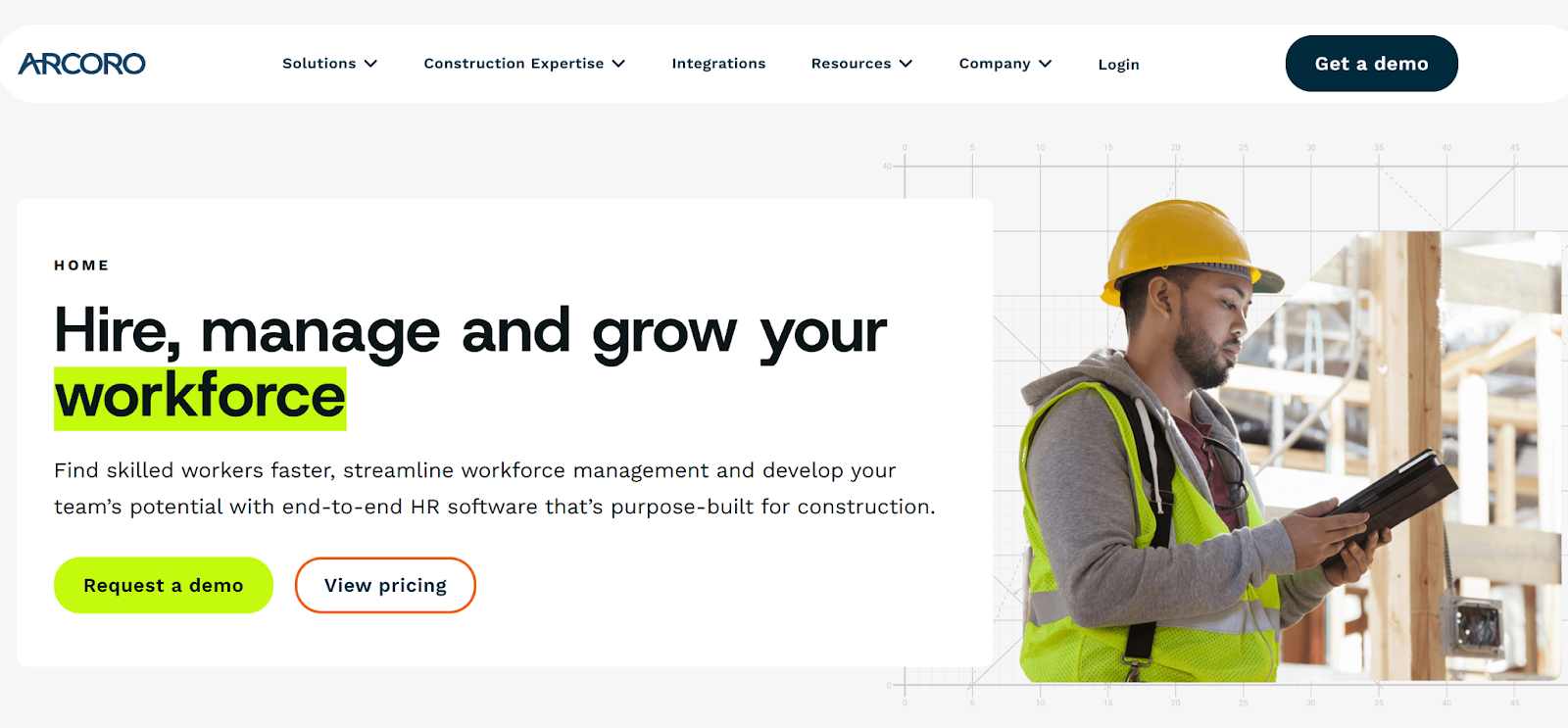
Arcoro delivers a modular HR suite built specifically for the construction industry, combining products like:
- ExakTime for time tracking
- BirdDogHR for talent management
- InfinityHR for core HR and benefits
Together, they create a flexible system aimed at contractors managing large, distributed field crews.
Its strongest edge is in jobsite-ready time capture and compliance-driven HR workflows. ExakTime’s mobile app supports several key time tracking features for construction crews. Arcoro also integrates with major construction systems (Procore, Trimble Viewpoint Vista, and Acumatica) to keep project and people data aligned.
Strengths
- Construction-Specific: Built from construction-specific products, with ExakTime delivering rugged, mobile, and GPS-enabled time tracking.
- Proven Integrations: Published integrations with Procore, Trimble Viewpoint Vista, and Acumatica, verified in the Trimble Marketplace.
- Strong Core HR: HR and compliance tools cover the essentials like hiring, onboarding, I-9/W-4, E-Verify, and safety training content aligned to OSHA standards.
Limitations
- Because Arcoro’s platform is assembled from multiple acquired tools, some modules rely on connectors or file transfers (SFTP). This can create workflow friction and data silos.
- Not all integrations apply across the full suite; some exist only at the module level.
Key Features & Integrations
- Complete HR Suite: Employee management, benefits, and onboarding.
- Field Time Tracking (ExakTime): GPS/geofencing, photo ID, and offline functionality for jobsites.
- Compliance Tools: I-9/W-4 forms, E-Verify, and background screening.
- LMS & Safety: Training content is linked to OSHA recordkeeping.
- Integrations: Arcoro can integrate with Procore, Trimble, and Acumatica for various workflows (mostly time and employee data transfers).
Ideal Fit
Arcoro is best for contractors with large, geographically dispersed crews who prioritize accurate field time tracking and mobile reliability. It’s a solid option for teams that can manage a modular setup and don’t mind a few manual sync workflows.
3. Trimble Viewpoint HR Management (Spectrum)
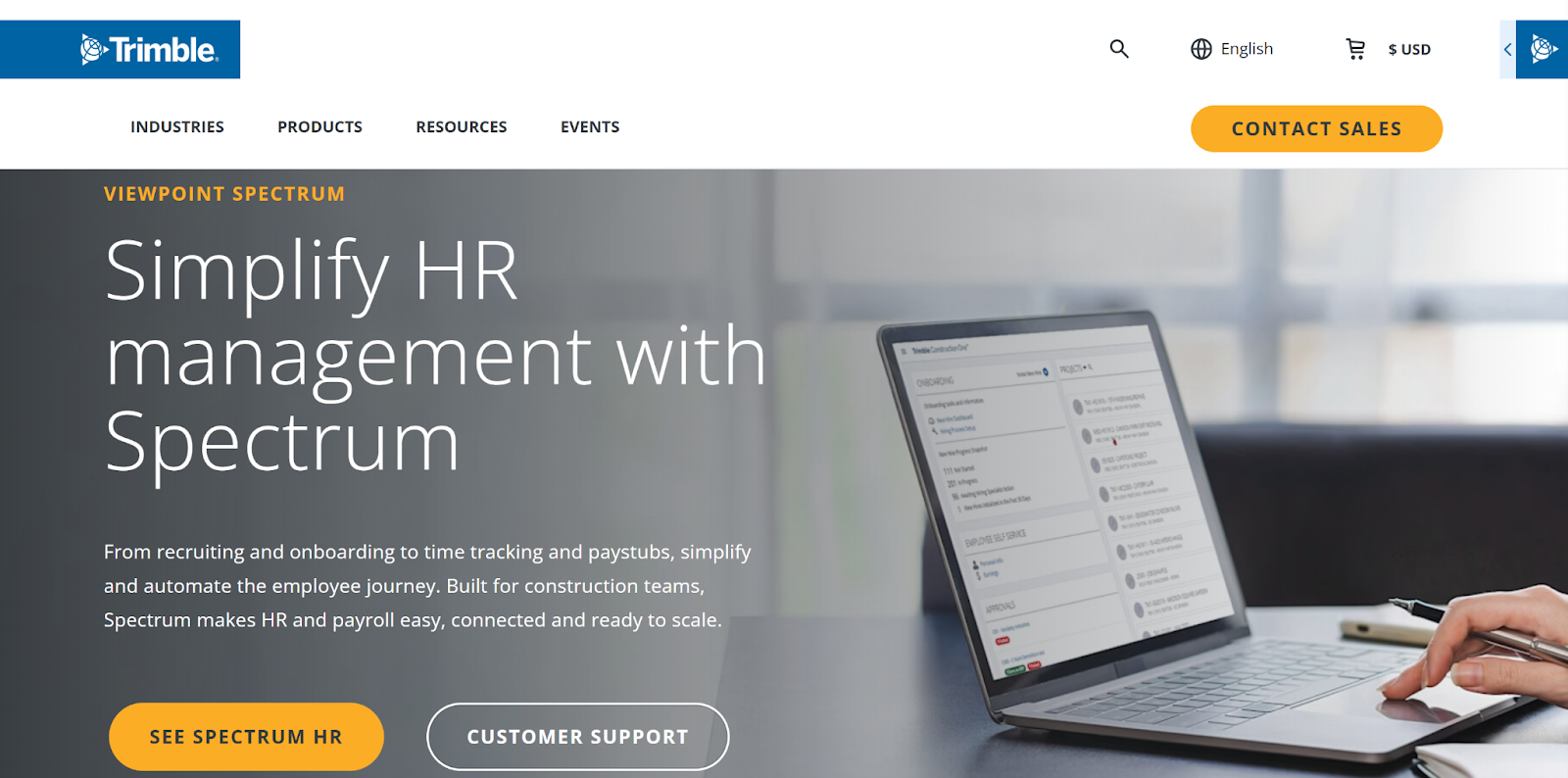
For contractors already using Trimble Viewpoint Spectrum (ERP), HR Management for Spectrum is an easy way to add an HRIS. Because it’s built natively into Spectrum, HR, payroll, and job-cost data share a single database, eliminating sync errors.
The platform digitizes key HR tasks while feeding data directly into Spectrum’s accounting and job-cost modules.
Strengths
- Native to Spectrum: Shares the ERP’s core data model, minimizing sync gaps and version mismatches.
- Construction-Specific Reporting: Includes built-in OSHA 300/300A/301 logs and multi-company compliance reporting.
- Ecosystem Flexibility: Connects through the Procore/Spectrum ERP connector and Trimble Marketplace apps for adjacent workflows.
Limitations
- Integration scope varies. The Procore/Spectrum integration covers select financial and project data, but not time or HR objects.
- Some users find report customization limited without technical support.
- The learning management system requires an add-on (Trimble Learn).
Key Features & Integrations
- Employee Self-Service (ESS): Employees manage personal details, W-2s, and requests through a web portal; HR controls access and approvals.
- Paperless Onboarding & I-9 Workflows: Streamlined hiring packets and compliance checks for remote or distributed crews.
- Jobsite Timesheets: Capture labor and equipment time by job or phase; approvals sync directly into Spectrum for payroll and job costing.
- OSHA & Safety Tracking: Log incidents, generate 300/300A/301 reports across multiple entities.
- HR Reporting Library: Standard and compliance-ready reports are built into Spectrum’s HR module.
- Integrations: Connects with Procore and Spectrum ERP for seamless data flow. The ERP also supports advanced HRIS features through the Sage HCM integration, and extends workflows via Trimble App Xchange add-ons.
Ideal Fit
Best for contractors already standardized on Spectrum who want HR, payroll, and safety tracking directly within their ERP. Ideal where HR teams need tight financial integration, OSHA-ready reporting, and audit-grade control (without juggling multiple systems).
4. Miter
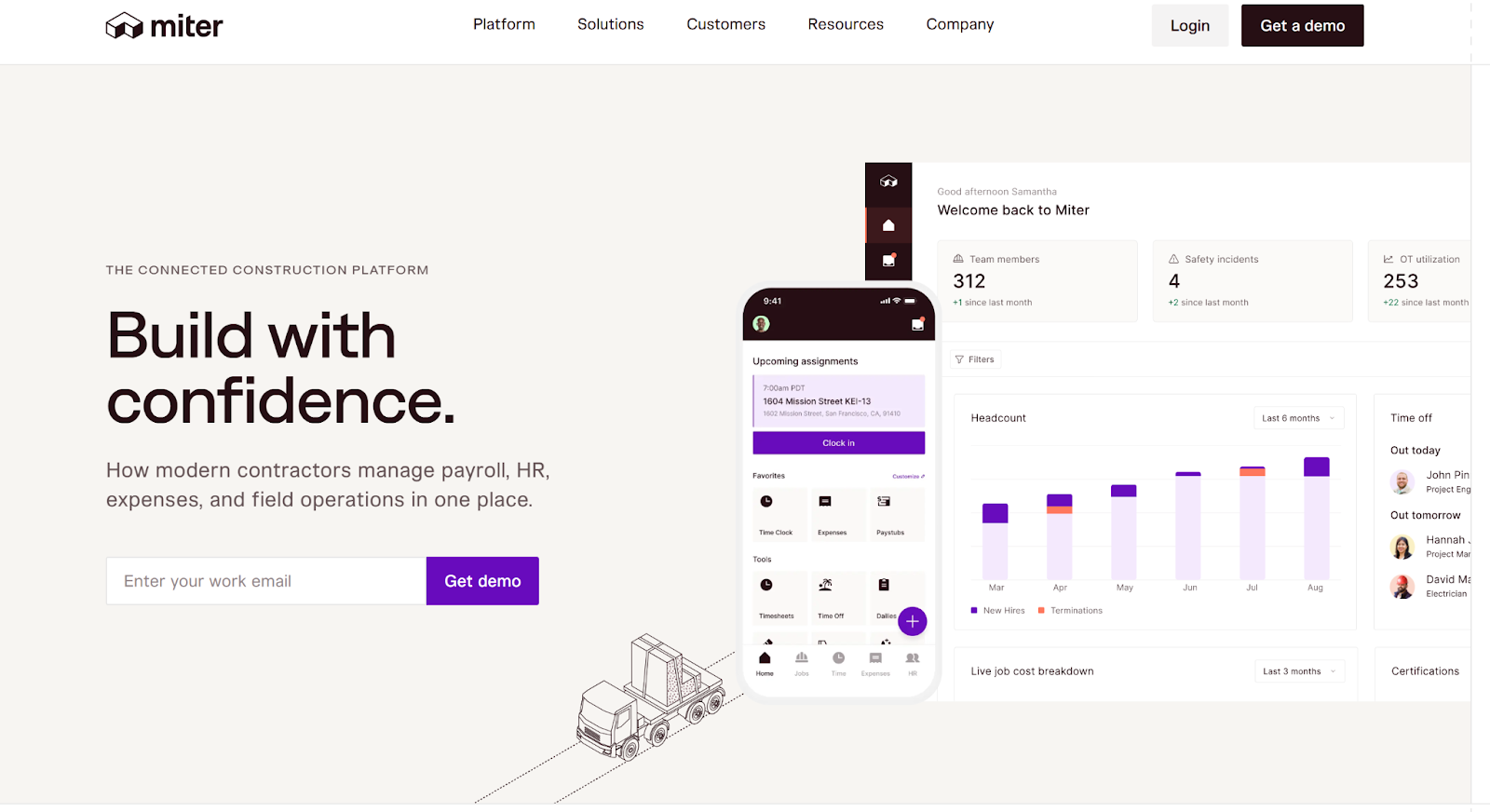
Miter is a construction-specific HCM for contractors that combines HR, payroll, and field operations features in a single system.
Newly founded in 2021, the platform is already gaining traction with construction companies because it is built for the realities of the industry.
Miter now integrates directly with Sage Intacct and Procore, allowing payroll and HR data to stay synchronized with job and cost-code information. This design helps contractors avoid rework and duplicate entry while keeping HR, accounting, and project data aligned.
Strengths
- Built specifically for contractors with features for certified payroll, prevailing wage, and union-rate handling.
- For teams transitioning between ERPs, Miter also helps maintain payroll continuity during migration. Teams can continue running payroll and job-cost tracking while upgrading financial systems.
- Integrations with key construction products like Sage Intacct and Procore.
Limitations
- Fewer public reviews and long-term references than legacy systems. Buyers should ask for demos to prove functionality.
- Outside of Sage and Procore, integrations are less clear. Buyers should check for coverage for tools like Acumatica, QuickBooks, or Xero (e.g., what objects sync and in which direction).
Key Features & Integrations
- HRIS & Employee Self-Service: Keep all employee data, onboarding, and updates in one place with an easy-to-use self-service portal.
- Built-In LMS: Create and track onboarding, safety, and compliance training.
- Compliance Automation: Instantly generate certified-payroll and union-fringe reports, plus workers’ comp records for audits.
- Time & Field Operations: Sync projects, cost codes, and timesheets from Procore to manage labor and job costs accurately.
- Expense Management: Record and approve expenses within the same system to link cost and people data.
- Integrations: Verified connections with Sage Intacct and Procore for project and cost exports, with additional integrations available through their marketplace and partners.
Ideal Fit
Miter is a good fit for contractors seeking a modern, construction-only HRIS that automates compliance and admin work.
It’s especially valuable for firms using Sage Intacct or Procore that need built-in certified-payroll exports and job-cost-aware time tracking (all without stitching together multiple generic tools).
{{inline-cta-solutions-hr-leader=”/style-guide”}}
5. ADP Workforce Now for Construction
ADP Workforce Now for Construction is the industry-specific version of ADP’s flagship HCM suite. It brings together HR, time, payroll, job-costing, and compliance reporting in a single system — backed by ADP’s Construction Center of Excellence.
The platform is designed to handle union rules, certified payroll, and job-cost allocation while posting payroll and GL data directly into your accounting or ERP system.
For contractors, that means enterprise reliability with features that can be configured for complex payroll needs. ADP also offers contractor-focused guidance and templates for certified payroll and OSHA recordkeeping. All of this makes ADP a familiar choice for teams that want brand-name dependability in one platform.
Strengths
- Built-For-Construction Edition: This version of Workforce Now is designed specifically for construction. It includes unique features like job-cost and GL posting, plus industry-specific reports.
- Enterprise Reliability: ADP’s infrastructure has proven effective with HR, time, and payroll functionality.
- Integration Flexibility: ADP has many verified partner connectors for Procore and ERP integrations through Flexspring, Workato, and Tray.ai.
Limitations
- Most data flows with ERPs or Procore run through third-party connectors and require scoped setup.
- Deep construction details may need configuration or add-ons. For example, WH-347 and some state reports may require extra modules or partner tools, which isn’t ideal.
Key Features & Integrations
- HR & Employee Self-Service: Manage central employee records, onboarding, documents, and self-service forms.
- Time, Scheduling, and Payroll: Track labor by job, process payroll, and post job-cost/GL data into your ERP.
- Compliance Reporting: Generate reports for certified payroll, prevailing wage, and state/federal taxes directly in-product.
- Safety & OSHA Reporting: Standard Workforce Now outputs include OSHA 300A and 301 summaries.
- Integrations: The platform integrates directly with Procore, but must be done via Flexspring. The platform also integrates with ERP platforms for GL and journal entity transfers via the ADP marketplace.
Ideal Fit
ADP Workforce Now for Construction is best for mid-to-large contractors that want the breadth and reliability of a major HCM provider.
It’s especially strong for firms that prefer partner-managed integrations and want to lean on ADP’s construction-specific edition for certified payroll and OSHA compliance.
6. CMiC HCM & Payroll
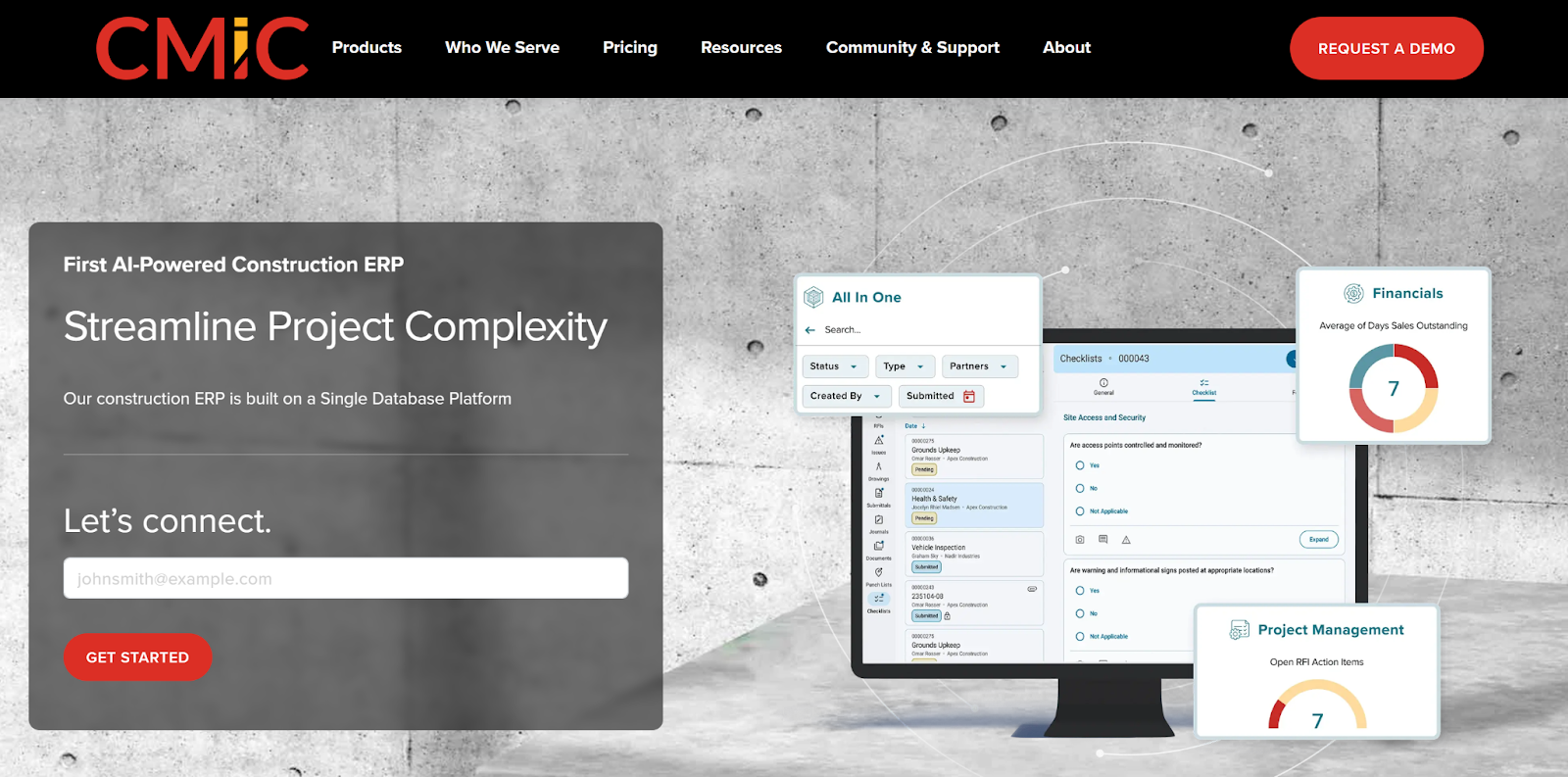
CMiC delivers a true all-in-one approach for construction management, combining HR, payroll, job cost, and compliance inside one ERP database.
Unlike bolt-on HR tools that sync data across systems, CMiC keeps everything within a single platform. This design eliminates duplicate entry and gives finance and HR a single source of truth.
HR teams can manage union benefits, track safety incidents, and process payroll data that ties directly into job costing in the same system.
Strengths
- Single-Database Architecture: HR, payroll, and financials share one environment, reducing data errors and improving audits.
- Construction-Native Design: OSHA 300/300A/301 reporting and safety codes are built into the HR module.
- Proven Integrations: Works with Procore, Vista, and Acumatica for added flexibility.
- Union and Multi-State Support: Handles complex pay and benefits eligibility across jobs and locals.
Limitations
- CMiC’s strength is being all-in-one, but its marketplace of third-party integrations is limited. Buyers should confirm module scope during demos.
- Requires an add-on for LMS features, though CMiC’s open API supports easy connections.
- Users report poor UX that feels outdated, which can create friction with adoption
Key Features & Integrations
- Employee Self-Service (ESS): Employees can update profiles and manage benefits; HR sets permissions through control settings.
- Digital Onboarding & Personnel Files: Centralized records keep documentation organized and accessible.
- Union-Aware Benefits Administration: Assign benefit plans by company, job, or union for clean eligibility and reporting.
- Time & Attendance Tied to Job Phases: Track where and when work occurred to support payroll and job costing.
- Safety & OSHA Reporting: Generate OSHA logs with safety code tracking.
- Certified Payroll & Compliance: Built-in reporting that connects directly to payroll and job cost data.
- Integrations: It’s best known integration is with Procore (popular project management tool for construction). However, it only maps certain items, so verify before buying.
Ideal Fit
CMiC is best for contractors seeking a unified ERP + HCM system where HR, safety, and payroll operate from one compliant database. It’s a strong choice for mid- to large-size organizations that value data integrity and financial visibility.
7. eBacon
eBacon is a construction payroll and compliance platform built for contractors under Davis-Bacon and prevailing wage laws. It unifies HR, payroll, time tracking, certified payroll reporting, and fringe benefit management in one system.
eBacon’s strength is its compliance-first design centered on certified payroll, prevailing wage calculations, and restitution accuracy. However, this sometimes means its focus isn’t entirely on people but compliance.
Beyond software, eBacon also serves as an educator. Their team offers plain-language guides and resources that help HR and accounting teams navigate complex wage rules and avoid errors.
Strengths
- Compliance-First Design: Built specifically for certified payroll, prevailing wage, and fringe benefit compliance, with clear step-by-step WH-347 and SoC guidance.
- Construction-Ready Payroll: Built to handle many of the complex requirements of construction payroll, including union rules.
- Accounting Integration: Connects with QuickBooks Desktop and Sage 100 to keep payroll and accounting data aligned.
Limitations
- Strongest in payroll and compliance; broader HR functionality (like performance or learning management) is minimal.
- Integration coverage is narrower (primarily Procore and select accounting platforms). Teams using other platforms will need to confirm compatibility.
- Some users note that customization and navigation could be more intuitive.
Key Features & Integrations
- Certified-Payroll Automation: One-click WH-347 and Statement of Compliance generation with built-in validation and error detection.
- Prevailing Wage & Fringe Management: Automatically applies correct wage determinations and fringe rates; includes guidance on cash vs. benefit strategies.
- Auto-Restitution Tools: Detects underpayments, recalculates rates, and regenerates corrected reports for full compliance.
- Time and Attendance From the Field: Integrates with Procore Time Cards to import jobsite hours and run payroll using prevailing wage and fringe data.
- Accounting Sync: Updates job lists and GL records automatically with QuickBooks Desktop and Sage 100.
Ideal Fit
eBacon is best for contractors who prioritize certified-payroll accuracy and fringe benefit compliance over a broader HR suite.
It’s also a good match for firms using Procore for time tracking and QuickBooks or Sage 100 for accounting. Teams that need airtight compliance, simple integrations, and practical, educational support may benefit from eBacon.
Final Thoughts
Choosing the right HRIS for construction depends on your priorities. Some platforms excel at field-time capture, others at compliance or ERP connections.
If your team manages multi-union payroll, certified rates, or complex job costing, you need a system that handles those challenges without workarounds. Generic HR tools weren’t built for this complexity, and they often leave compliance and reporting gaps.
That’s where Sage HCM stands out. It’s a complete, construction-ready HRIS that unifies HR, payroll, time, and talent in one secure database. With integrations for other Sage products, Trimble Vista/Spectrum, Procore, and Acumatica, Sage HCM streamlines work that’s relevant to construction.
Ready to modernize your construction HR? Book a Sage HCM demo to learn more.


